Newsroom employment across the United States continues to decline, driven primarily by job losses at newspapers. And even though digital media outlets experienced some growth in employment, too few newsroom positions were added to make up for losses in the broader industry, according to an analysis of U.S. Bureau of Labor Statistics Occupational Employment and Wage Statistics (OEWS) data.
From 2008 to 2025, newsroom employment in the U.S. dropped by 40 percent. In 2008, about 114,000 newsroom employees—reporters, editors, photographers, and camera operators and videographers—worked in four industries that produce news: newspaper, radio, broadcast television, and digital media. By 2025, that number declined to about 69,000, a loss of about 46,000 jobs (see Figure 1).
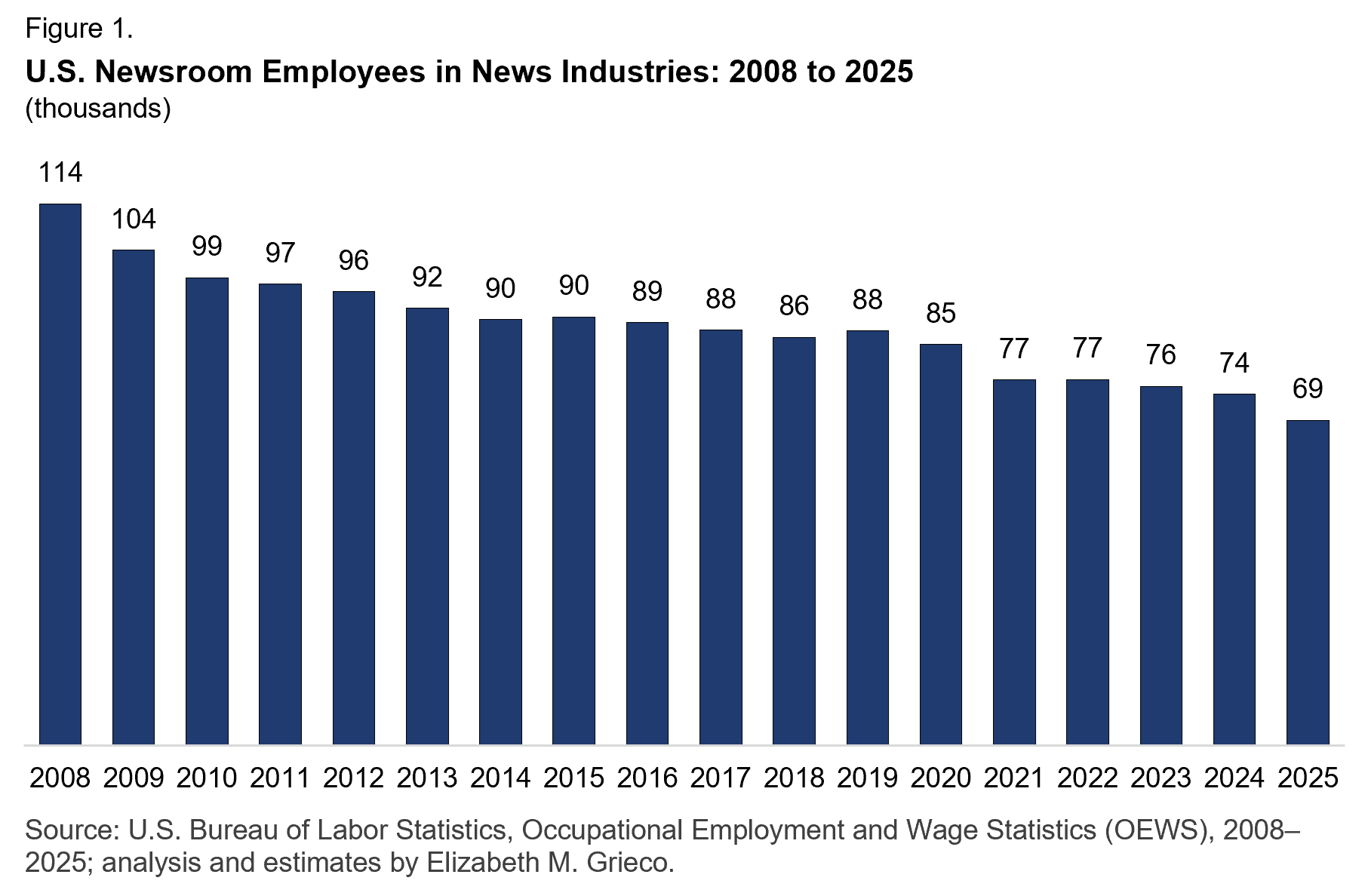
Newsroom employment has not declined at a uniform pace over the period examined. More than half (52 percent) of the total 2008–2025 decline occurred between 2008 and 2015. The pace of the decline slowed between 2015 and 2020, accounting for just 13 percent of the total decline, before accelerating again after 2020, when more than a third (35 percent) of the total decline occurred.
This decline in overall newsroom employment was driven primarily by one sector: newspapers. Newspaper newsroom employees dropped by 61 percent over the period, from about 71,000 workers in 2008 to 28,000 in 2025, a loss of about 43,000 jobs (see Figure 2).
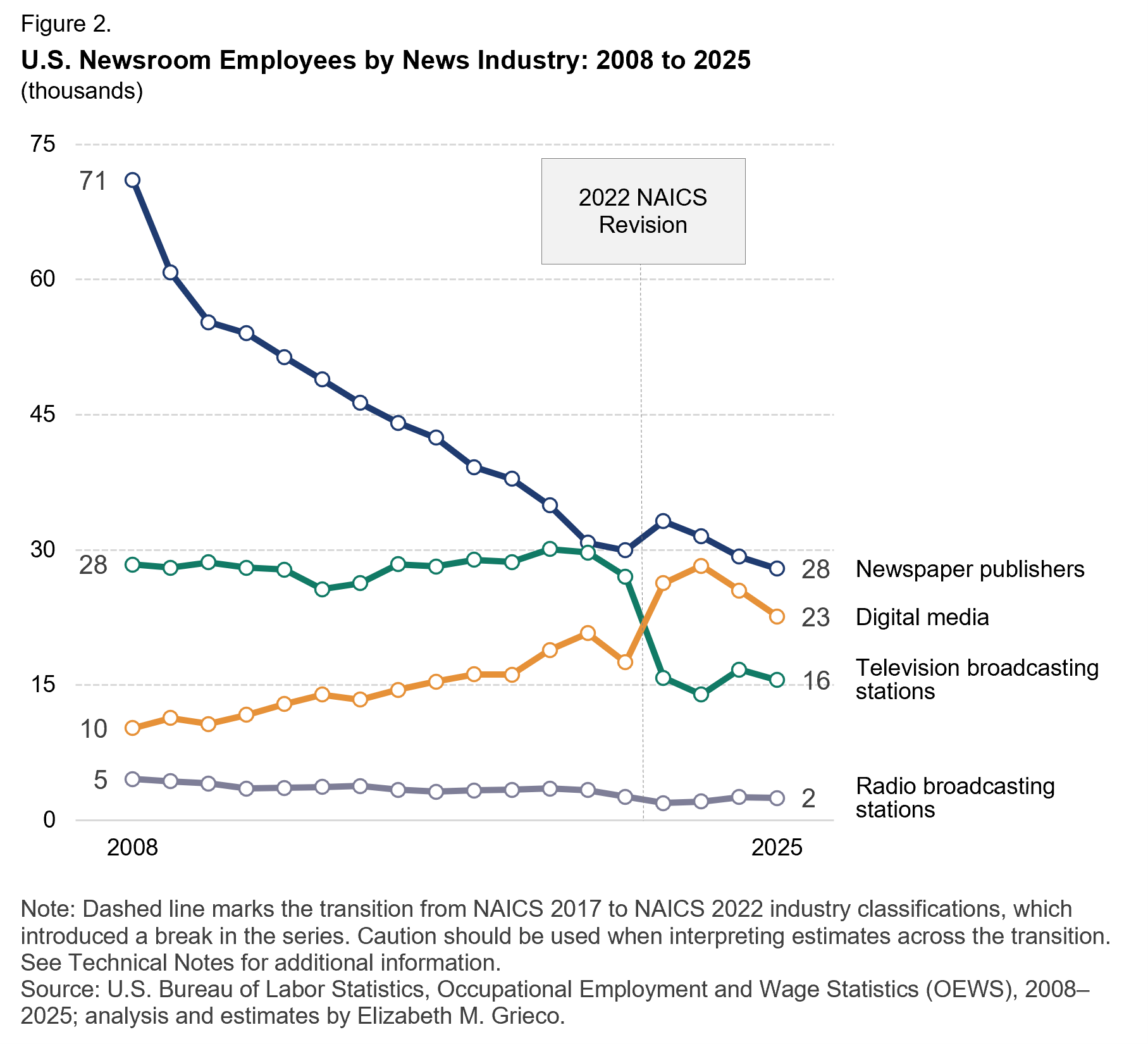
In 2022, the OEWS adopted the new North American Industry Classification System (NAICS). This change had little impact on the total number of newsroom employees but did alter the trend lines for specific news-producing industries, especially television broadcasting and digital media. This reclassification largely explains the trend line “flip” (see Figure 2), where the drop in the number of newsroom employees at television broadcasting stations mirrors the increase in the number working at digital media establishments. The reclassification also helps explain the small increase in newspaper newsroom employment between 2021 and 2022, as some establishments previously classified under Internet Publishing and Broadcasting and Web Portals were reclassified as Newspaper Publishers. For additional information, see Technical Notes.
Taken together, the remaining industries—radio and television broadcasting stations and digital media—were relatively stable over the period, dropping by just 6 percent, from about 43,000 in 2008 to 41,000 in 2025. Despite growth in the digital media sector during this period, the three industries combined lost about 2,500 jobs, adding to the overall decline in newsroom employment.
The dramatic decline in newspaper employment also means that the industry now accounts for a smaller portion of overall newsroom employment across the four sectors. In 2008, newspaper newsroom employees made up about 62 percent of all newsroom employees in these four industries, but that share dropped to 41 percent by 2025 (see Figure 3).
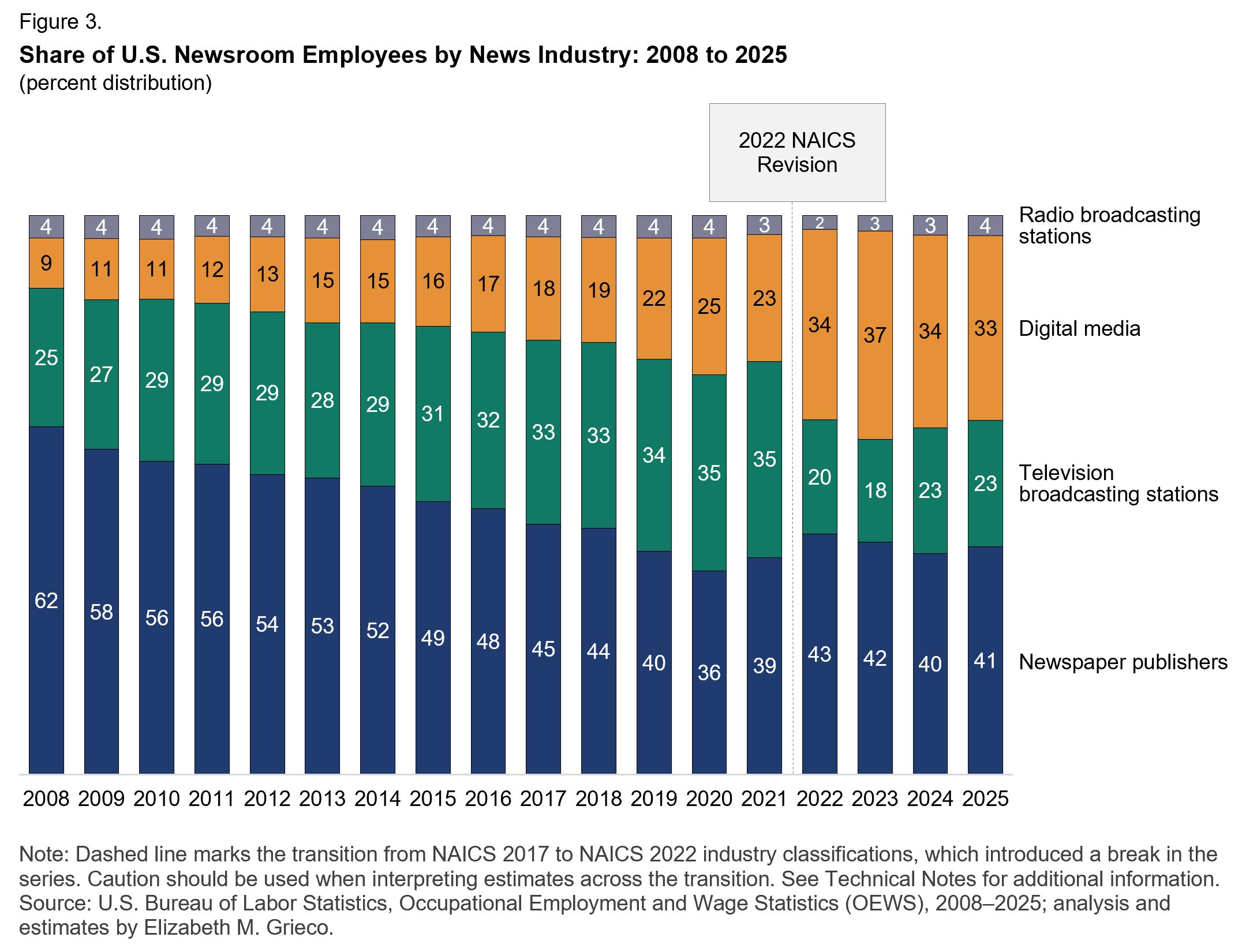
Conversely, digital media now accounts for a larger portion of newsroom employment, increasing from about 9 percent in 2008 to 33 percent in 2025. Some of the increase after 2021 can be attributed to the OEWS reclassification of establishments among industries; see Technical Notes.
Radio and television broadcasting stations represented about the same share of newsroom employment in 2008 and 2025—4 percent in both years for radio and about a quarter for television (25 percent in 2008 and 23 percent in 2025).
Of the occupations included in this analysis, reporters and editors make up the bulk of newsroom employees. On average over the period, about 47 percent were news analysts, reporters, and journalists and 22 percent were editors.
Additional information
U.S. newsroom employment was estimated using data from the U.S. Bureau of Labor Statistics (BLS) Occupational Employment and Wage Statistics (OEWS) program for 2008 through 2025. The OEWS program produces annual estimates of occupational employment and wage rates for full- and part-time wage and salary workers (excluding the self-employed) in nonfarm establishments.
This analysis includes newsroom employees in four media-related occupations—news analysts, reporters, and journalists; editors; photographers; and television, video, and film camera operators and editors—working in four news-producing industries: newspaper publishers; radio broadcasting stations; television broadcasting stations; and media streaming distribution services, social networks, and other media networks and content providers.
For convenience, the media streaming distribution services, social networks, and other media networks and content providers industry is referred to as digital media in the text, graphs, and tables. This industry comprises establishments primarily providing media streaming distribution services, operating social network sites, operating media broadcasting and cable television networks, and supplying information, such as news reports, articles, pictures, and features, to the news media.
The estimates do not include self-employed workers, such as freelancers, independent contractors, or citizen journalists. Reporters, editors, photographers, and camera operators and videographers employed outside the selected industries were also excluded from the estimates.
For additional information, see Technical Notes.
Elizabeth M. Grieco, Ph.D.
Independent Researcher
August 12, 2026
Website: elizabethgrieco.com