These Technical Notes describe the data sources and methodology used to estimate newsroom employment in the United States between 2008 and 2025.
Data Source
The newsroom employment estimates were compiled using data from the U.S. Bureau of Labor Statistics (BLS) Occupational Employment and Wage Statistics (OEWS) program, which produces annual employment and wage estimates for approximately 830 occupations across nearly 1.1 million business establishments (based on a three-year survey cycle). Estimates are available for the nation, states, metropolitan and nonmetropolitan areas, and detailed industries. For additional information about the OEWS survey, see Occupational Employment and Wage Statistics: Overview.
This analysis uses the OEWS National Industry-Specific and By Ownership data tables available on the BLS website. Annual newsroom employment totals were constructed from the published industry and occupation estimates for 2008 through 2025.
The estimates include full- and part-time employees working in news-producing establishments. They do not include self-employed workers, such as freelancers, independent contractors, or citizen journalists.
Methodology
For each data year, newsroom employment was estimated by summing the number of employees working in selected news-related occupations within selected news-producing industries.
Occupations
The OEWS uses the Standard Occupation Classification (SOC) system, the federal statistical standard used for classifying workers by occupation. All workers are classified into one of 867 detailed occupations according to the work they perform.
Four SOC occupation categories were used to estimate newsroom employees, including:
- SOC-27-3020: News Analysts, Reporters, and Journalists
- SOC-27-3041: Editors
- SOC-27-4020: Photographers
- SOC-27-4030: Television, Video, and Film Camera Operators and Editors
The selected occupations represent employees engaged primarily in news gathering, editing, production, and presentation. Administrative, advertising, printing, circulation, technical support, and other non-newsroom occupations were excluded. Additionally, reporters, editors, photographers, and camera operators and videographers employed outside the selected industries (see below) were also excluded from the estimates.
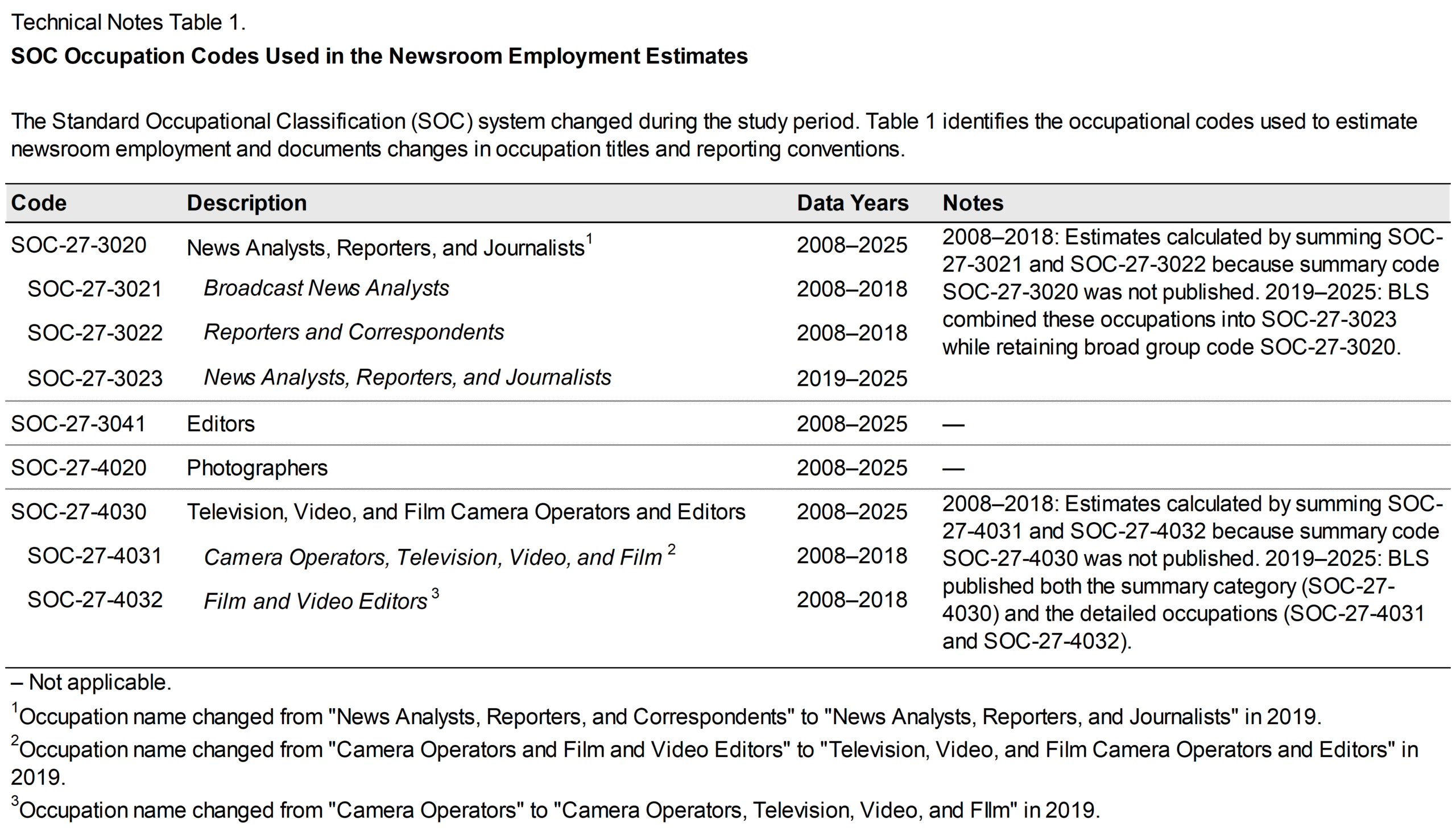
OEWS data for the 2008–2025 period covers three SOC systems: 2000, 2010, and 2018. Across these three systems, the occupation codes used in the newsroom employee estimates remained stable, with minor changes. Table 1 summarizes the SOC codes used in the analysis and documents changes in occupation titles and reporting conventions over time.
Industries
In addition to SOC codes, the OEWS also uses the North American Industry Classification System (NAICS), the federal standard for classifying business establishments by industry.
Four NAICS categories were used to estimate newsroom employees, including:
- NAICS 513110: Newspaper Publishers
- NAICS 516110: Radio Broadcasting Stations
- NAICS 516120: Television Broadcasting Stations
- NAICS 516200: Media Streaming Distribution Services, Social Networks, and Other Media Networks and Content Providers
NAICS Revisions
The 2008–2025 data range covers three NAICS systems: 2012, 2017, and 2022. While the news-related industries between the 2012 and 2017 systems remained relatively unchanged, the 2022 NAICS includes significant changes to the information industry, which includes the newspaper, radio, television, and digital media establishments.
Despite the extensive restructuring of media industries under the 2022 NAICS revision, the industries used in the newsroom employment estimates remained largely comparable over time. The primary effect of the revision was to reclassify activities among industries rather than alter the conceptual scope of the estimates.
While these changes had little impact on the estimate of the total number of newsroom employees, they did alter the trend lines for the specific news-producing industries, especially television broadcasting stations and digital media.
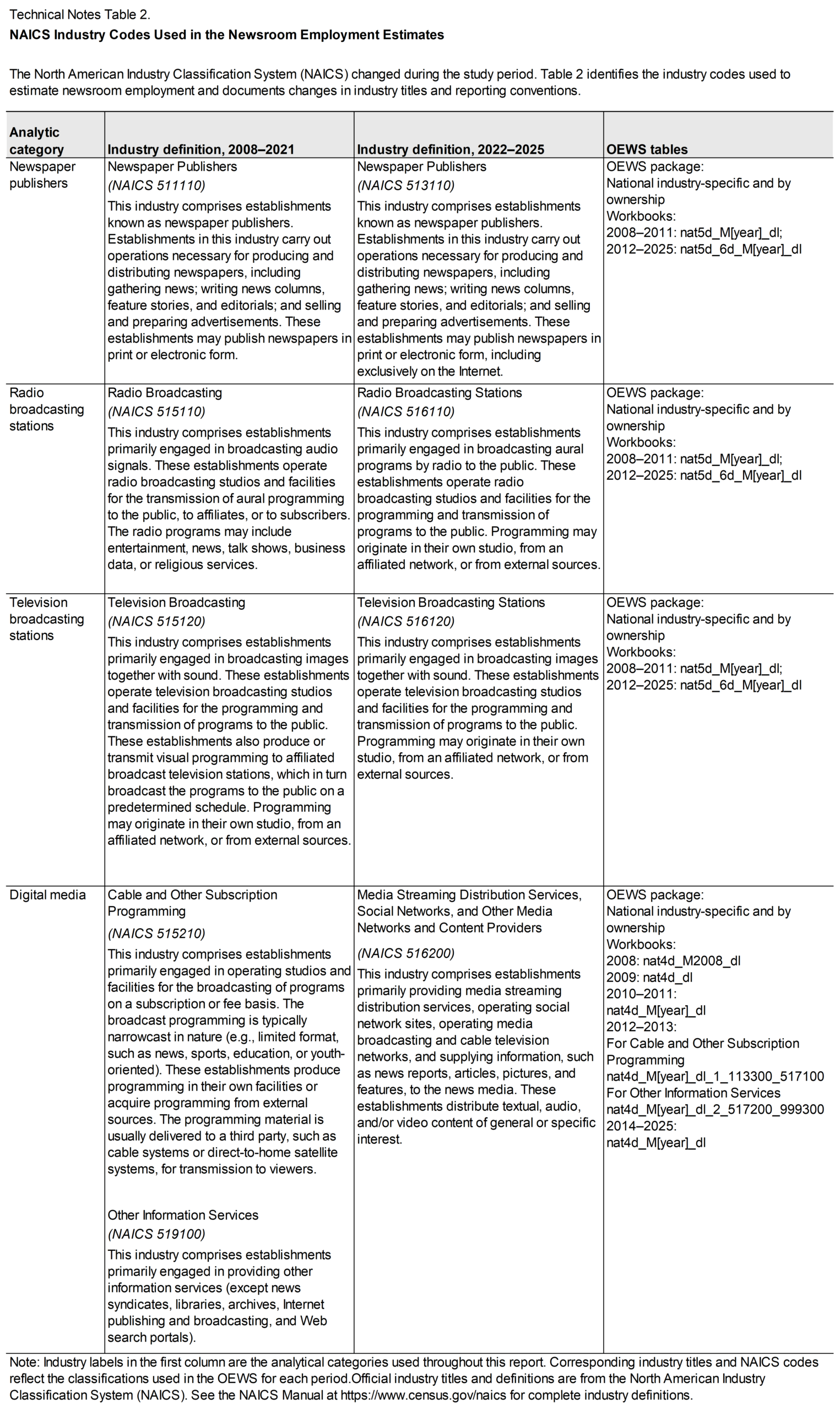
When developing the newsroom employee estimates based on the older NAICS systems (2008–2021), five industry categories were used: Newspaper Publishers, Radio Broadcasting, Television Broadcasting, Cable and Other Subscription Programming, and Other Information Services. The NAICS codes and industry definitions for both the pre- and post-2022 NAICS changes are shown in Table 2.
Between the 2017 and 2022 NAICS systems, three changes had the greatest impact on the estimates:
- The creation of a new Media Streaming Distribution Services, Social Networks, and Other Media Networks and Content Providers category in 2022, which incorporated establishments previously categorized in 2017 as part of the Radio Broadcasting, Television Broadcasting, Cable and Other Subscription Programming, and Other Information Services industries.
- Related to the above change, the 2017 category of Television Broadcasting–Television Networks (part of the larger Television Broadcasting industry) was moved to the new Media Streaming Distribution Services, Social Networks, and Other Media Networks and Content Providers category in 2022. This reclassification largely explains the trend line “flip” seen in Figure 2, where the drop in the number of newsroom employees at television broadcasting stations mirrored the increase in the number working at digital media establishments.
- The division of the 2017 category of Internet Publishing and Broadcasting and Web Portals into three parts, reclassifying those establishments in 2022 into three different industries (Newspaper Publishers; Media Streaming Distribution Services, Social Networks, and Other Media Networks and Content Providers; and Web Search Portals and All Other Information Services). This helps explain the “bump” in newsroom employment at newspaper publishers seen between 2021 and 2022 on Figure 2.
Table 3 provides a crosswalk between the 2017 industry codes and their treatment under the 2022 classification, documenting how the industries used to estimate newsroom employment correspond to the revised NAICS and identifying the principal reclassifications affecting the analysis.
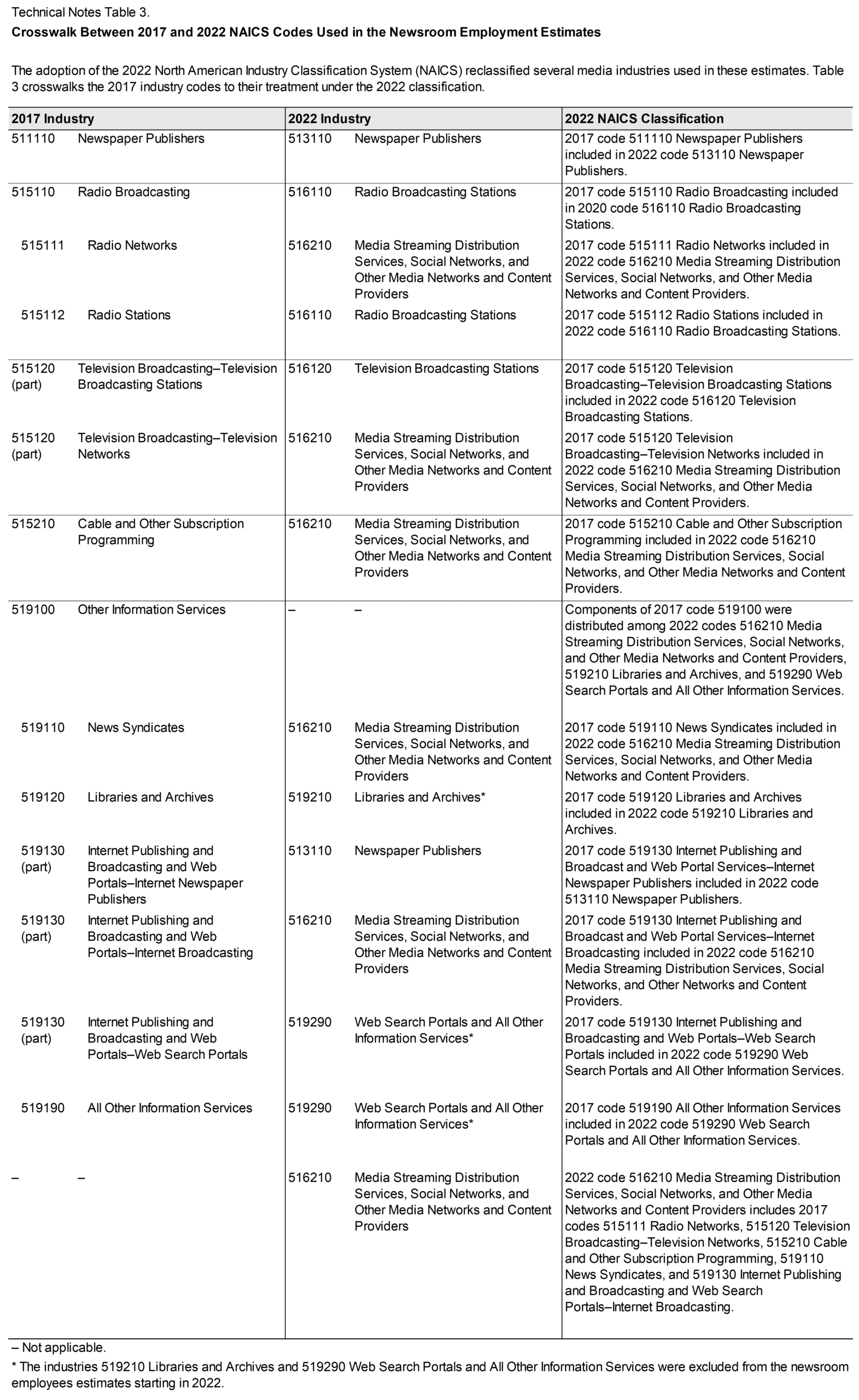
Two industries were dropped from the newsroom employee estimates after the OEWS adopted the 2022 NAICS. In the 2008–2021 estimates, the industry categories of 515210 Cable and Other Subscription Programming and 519100 Other Information Services were combined to create the annual Digital Media estimate. Although the individual NAICS sub-codes under 519100 Other Information Services are shown in Table 3, the published OEWS data tables reported employment only for the summary category. As a result, the individual components could not be estimated separately for 2008–2021.
However, starting in 2022, 519100 Other Information Services was split among several categories, and 519210 Libraries and Archives and 519290 Web Search Portals and All Other Information Services could be excluded from the newsroom employees 2022–2025 estimates. It is likely that few newsroom occupations were employed in these industries and the removal of these categories had little impact on the newsroom employee estimates.
Validation
Earlier versions of newsroom employee estimates were compared with estimates derived from other government and private-sector data sources. The resulting trends were generally consistent, with differences largely attributable to differences in data collection methodology.
A summary of these comparisons was presented at the 2019 annual conference of the American Association for Public Opinion Research (AAPOR). The conference poster is available on the author’s website, and the presentation slides are available on the AAPOR website.
Elizabeth M. Grieco, Ph.D.
Independent Researcher
August 12, 2026
Website: elizabethgrieco.com