The United States is once again approaching a foreign-born population share not seen since the late 1800s and early 1900s, during the period known as the “Great Wave” of migration.
According to the U.S. Census Bureau, between 1880 and 1930, the foreign-born population grew rapidly, doubling in size from 6.7 million to 14.2 million. During this period, it represented roughly 12% to 15% of the total population (see figure below).
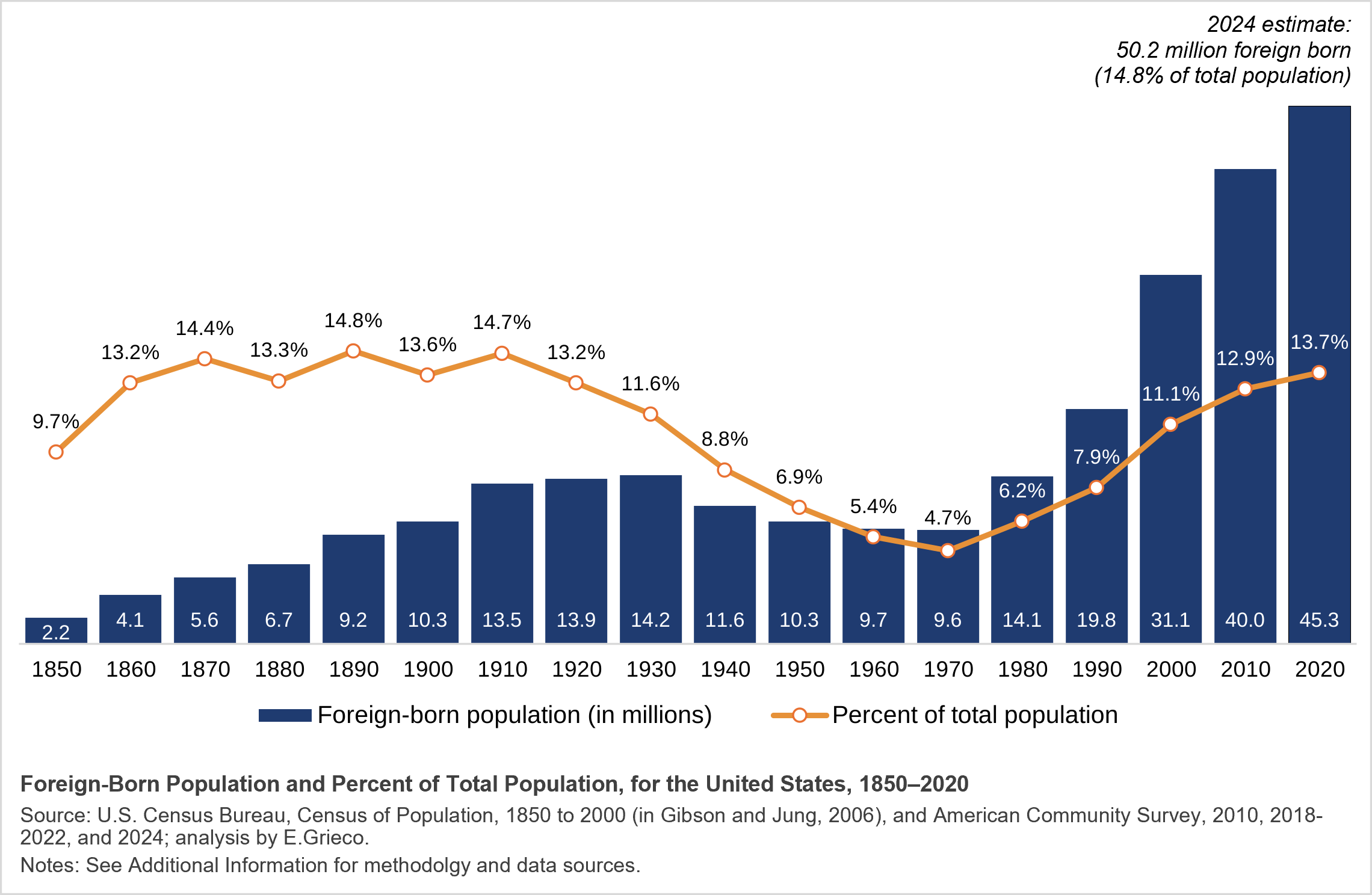
As immigration slowed after 1930 and the resident foreign-born population either died or emigrated, the population continued to decline, falling to 9.6 million in 1970—the lowest level of the 20th century. Less than 5% of the total population at that time, or fewer than 1-in-20 people, were foreign-born.
From 1970 to 2020, the foreign-born population steadily increased in both size and share of the total U.S. population. It grew nearly fivefold, reaching 45.3 million by 2020, when 13.7% of the total population—or nearly 1-in-7 people—were foreign-born.
Today, the share of the foreign-born population matches notable historic highs. According to the U.S. Census Bureau’s American Community Survey (ACS), there were 50.2 million foreign-born residents in the United States in 2024, representing 14.8% of the total population—a share not seen since 1890 (14.8%) and 1910 (14.7%).
If recent trends continue, the 2025 or 2026 ACS data could show the United States at 15% foreign born or higher, exceeding the historic high of 14.8%.
Additional Information
This article examines the growth in the foreign-born population in the United States between 1850 and 2020, focusing on both its size and proportion of the total population over time. The U.S. foreign-born share now rivals the historic highs seen during the “Great Wave” of migration in the late 1880s and early 1900s, and that level is likely to be exceeded in the next few years.
Historical estimates come from decennial census data, while more recent estimates are from the American Community Survey (ACS).
Data for 1850 to 2000 come from a U.S. Census Bureau working paper, Historical Census Statistics on the Foreign-Born Population of the United States: 1850 to 2000 (POP-WP081) by Campbell Gibson and Kay Jung (2006).
For 2010, the estimates were derived from the ACS 1-year file, as reported in working paper POP-WP096, The Size, Place of Birth, and Geographic Distribution of the Foreign-Born Population in the United States: 1960 to 2010 by Elizabeth Grieco et al. (2012).
The 2020 and 2024 estimates were derived from the ACS using the Table Finder available on data.census.gov, specifically Table B05002: Place of Birth by Nativity and Citizenship Status. ACS 1-year estimates were used for 2024, while the 2018–2022 ACS 5-year file was used for 2020 to provide midpoint estimates, as a 1-year file was not published.
Additional information about the ACS is available at census.gov/programs-surveys/acs, and for the decennial census, see https://www.census.gov/programs-surveys/decennial-census/technical-documentation/complete-technical-documents.html.
Elizabeth M. Grieco, Ph.D.
Independent Researcher
April 9, 2026