A previous post examined the distribution of the U.S. foreign-born population by state, showing both the number of foreign-born residents and their share of each state’s population. One clear takeaway was how concentrated this population is geographically.
More than half of the nation’s 50.2 million foreign-born residents live in just four states—California, Texas, Florida, and New York. Expanding to the 14 states with at least 1 million foreign-born residents captures fully 80% of the total.
But what happens when states are grouped not individually, but by partisan lean?
Using the Cook Political Report’s 2025 Partisan Voting Index, states can be classified as Republican-leaning (“Red”) or Democratic-leaning (“Blue”). Viewed this way, a different pattern emerges.
In 2024, a majority (57%) of the U.S. foreign-born population lived in Blue/Lean Blue states, compared with 43% in Red/Lean Red states. Naturalized citizens were even more concentrated in Blue states (61%), while a slight majority of noncitizens (53%) also resided there, as shown in the figure.
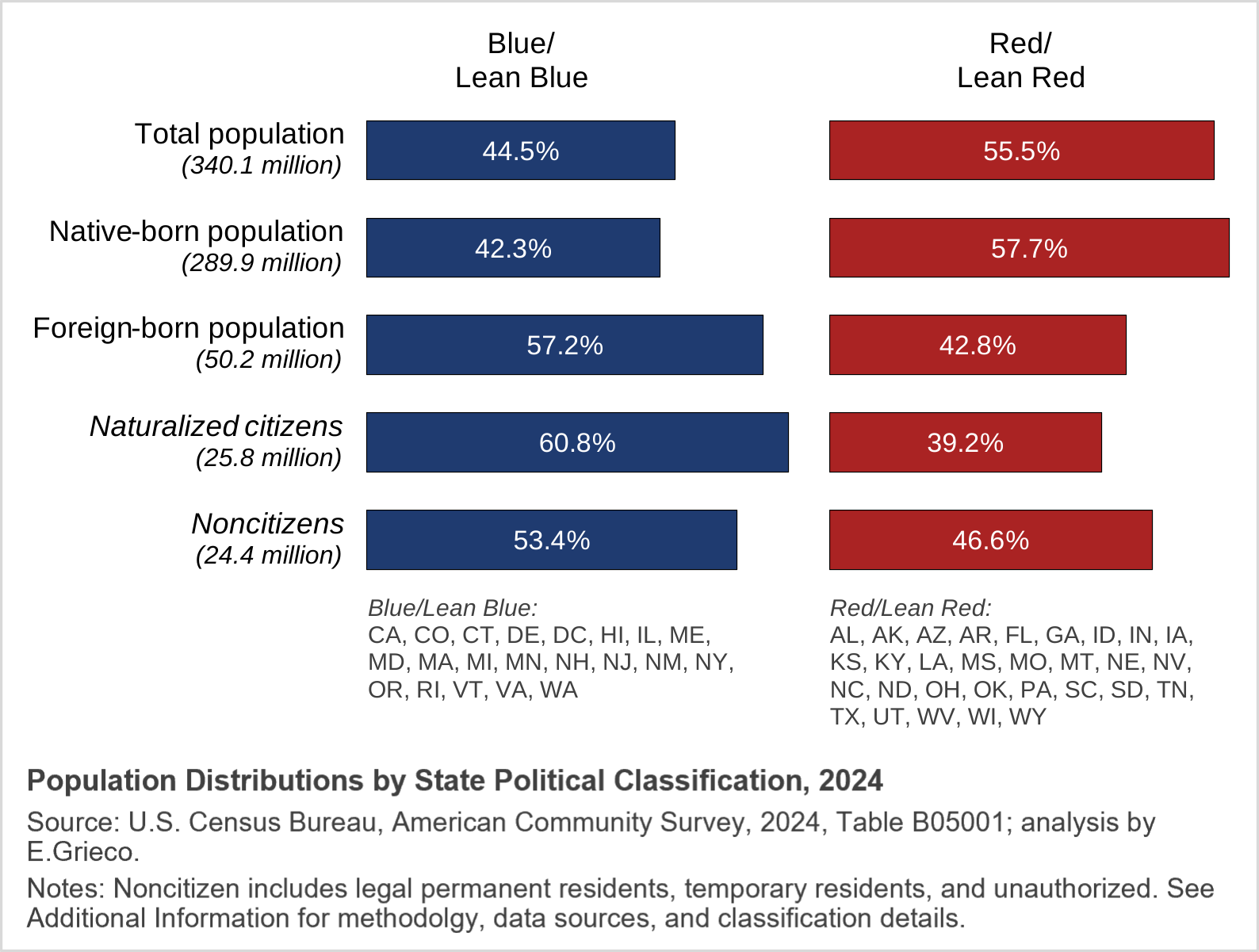
By contrast, the native-born population tilts in the opposite direction. Of the 289.9 million native-born Americans, 58% lived in Red/Lean Red states, compared with 42% in Blue/Lean Blue states.
The concentration of foreign-born residents in Blue states modestly shifts the overall population distribution toward those states. Even so, of the 340.1 million people in the United States, Red/Lean Red states remain home to a majority (55%), compared with 45% in Blue/Lean Blue states.
The data for this analysis come from the U.S. Census Bureau’s American Community Survey (see Additional Information for data sources and methods).
Additional Information
This analysis examines the distribution of the U.S. native-born and foreign-born populations across states grouped by partisan lean.
The data come from the U.S. Census Bureau’s American Community Survey (ACS). Estimates were derived from the 2024 ACS 1-year file using Table Finder on data.census.gov, specifically Table B05001: Nativity and Citizenship Status in the United States. All estimates are subject to sampling error, and all comparative statements have been tested for statistical significance at the 90% confidence level.
The ACS universe covers the entire resident population of the United States and Puerto Rico, including both housing units and group quarters (e.g., prisons, nursing homes, college dorms). It follows current residence rules, counting individuals where they live or stay, regardless of legal status or citizenship.
The native population includes U.S. citizens born in the United States, born in Puerto Rico or U.S. Island Areas, or born abroad of at least one U.S. citizen parent. The foreign-born population includes individuals born outside the United States to noncitizen parents (i.e., not U.S. citizens at birth).
The District of Columbia is treated as a state equivalent for statistical purposes in this analysis.
States were grouped into Red/Lean Red and Blue/Lean Blue categories based on the Cook Political Report Partisan Voting Index (PVI, 2025), which reflects average partisan performance across the two most recent presidential elections. Blue states are those with a Democratic PVI lean (D+), and Red states are those with a Republican PVI lean (R+). “Even” states in the Cook PVI were assigned using Cook rounding conventions, resulting in a single Red/Blue classification.
Elizabeth M. Grieco, Ph.D.
Independent Researcher
April 26, 2026
Website: elizabethgrieco.com